We live in a world that moves faster than the human soul was ever meant to. Every scroll, every ping, every headline asks us to respond now. But hea
We live in a world that moves faster than the human soul was ever meant to.
Every scroll, every ping, every headline asks us to respond now.
But healing, wisdom, and peace require something slower — the kind of focus that doesn’t rush to the finish line.
Cognitive patience is the grace of staying with a thought long enough to let it bloom.
It’s the skill of resting your mind where your body already is.
It’s what allows you to read, pray, think, and love deeply without scattering your energy.
If your mind has grown restless or your attention feels fragile, this isn’t failure — it’s fatigue.
And fatigue can heal.
Here are gentle, life-giving ways to rebuild that inner stillness and strength — ways that honor both your mind and your spirit.
🌿 1️⃣ Read slowly on purpose
-
Choose one article, passage, or verse and read it out loud or twice.
-
Linger on rhythm, tone, or imagery instead of information alone.
-
Use your voice as a grounding tool — it slows comprehension down and reconnects body to language.
Over time, your brain relearns that reading isn’t a race.
✨ 2️⃣ Practice sustained focus in short sessions
Start with 10-minute “single-focus” blocks — reading, journaling, sewing, or drawing — with no switching.
Gradually lengthen them.
This is interval training for your attention: small, steady expansions that rebuild stamina.
💛 3️⃣ Restore sensory stillness
-
Sit in silence for five minutes daily — no music, no scrolling, just breathing.
-
Observe one detail: the hum of a fan, a candle flame, your heartbeat.
Stillness teaches the nervous system to be comfortable without constant stimulation — the biological foundation of patience.
🔥 4️⃣ Handwriting or journaling
Writing by hand activates brain regions linked to memory, sequencing, and regulation.
It demands presence.
Even brief notes, copied scripture, or affirmations build the neural pathways for deeper focus and comprehension.
🌾 5️⃣ Gardening, quilting, cooking — embodied patience
Manual, repetitive tasks with a creative goal — kneading dough, tending a plant, stitching — retrain your body to stay with a process through small frustrations and rewards.
Your brain learns patience through your hands.
🕊️ 6️⃣ Deep conversation or attentive listening

When you listen to someone’s full story without planning your response, you’re exercising sustained attention and empathy — key elements of cognitive patience.
Healing circles, spiritual gatherings, or long talks with elders nurture this beautifully.
📖 7️⃣ Scripture or poetry meditation
Pick one verse, proverb, or poem line per day.
Read it, breathe, repeat.
Ask: “What does this reveal now?”
That simple act of rereading retrains your mind to linger rather than rush.
🌻 8️⃣ Digital boundaries
Create “slow zones”:
-
No multitasking while eating.
-
Screen-off hours before bed.
-
One day a week where you consume only long-form content, audio, or paper books.
This restores attention span by letting your brain reset from constant novelty.
💫 9️⃣ Faith practices of waiting
Prayer, fasting, Sabbath rest, lighting a candle — all invite surrender to time and uncertainty.
Spiritually, patience is trust.
Neurologically, it’s the regulation of impulse and anxiety.
Both feed each other.
🌺 Affirmation
I am learning to dwell again — in words, in silence, in myself.
My mind is patient. My thoughts have room to unfold.
🌺 Closing Reflection
Healing asks us to slow down — not because we are weak,
but because we’ve carried too much for too long.
Cognitive patience isn’t just about focus;
it’s about remembering that your mind deserves the same tenderness as your body and your heart.
Every time you pause, breathe, reread, or sit with your own thoughts,
you’re teaching your nervous system that safety is real,
that urgency no longer rules you,
and that peace can be practiced one quiet moment at a time.
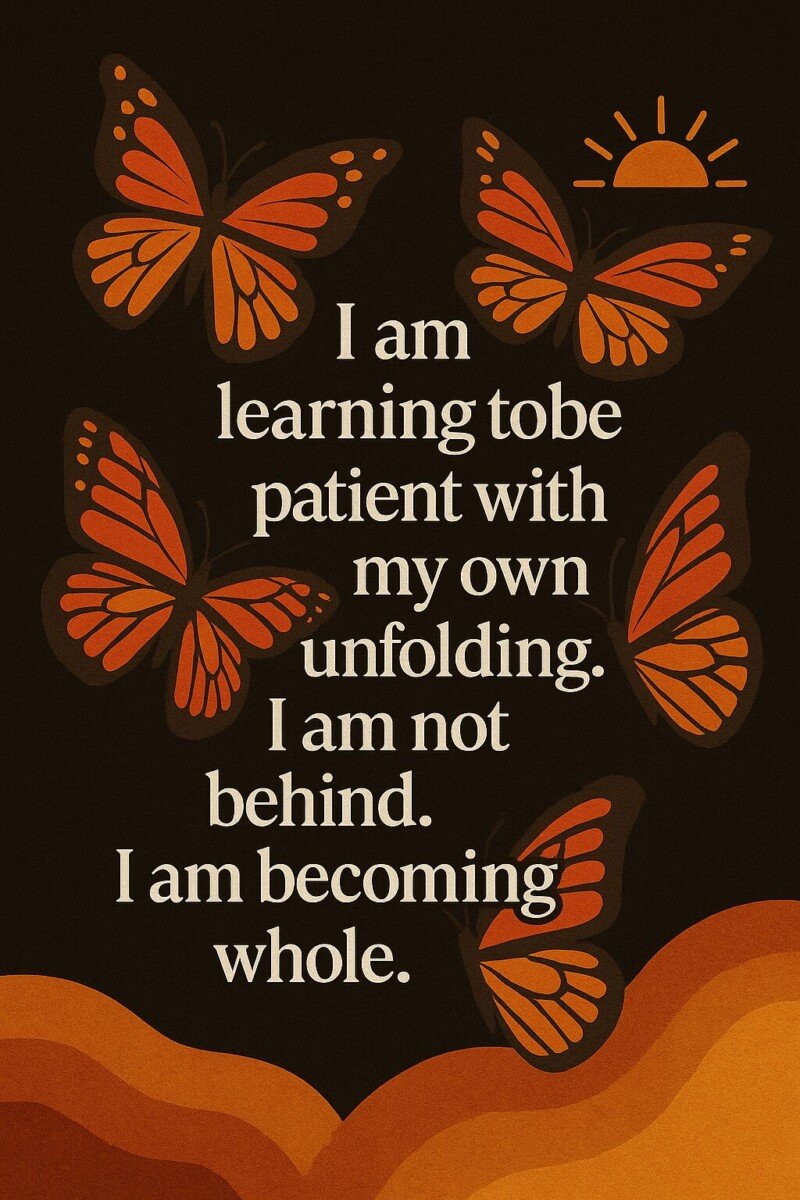
I am learning to be patient with my own unfolding.
I am not behind. I am becoming whole.