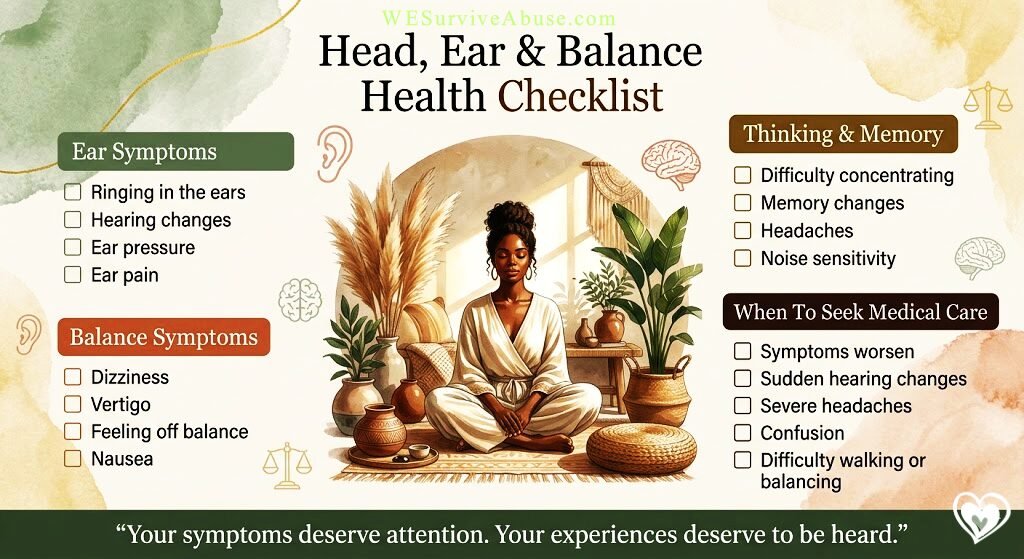
Many Survivors have told me some version of this: "I knew something felt wrong. I just didn't know what to call it." That is more co
 Many Survivors have told me some version of this:
“I knew something felt wrong. I just didn’t know what to call it.”
That is more common than people realize.
You do not need perfect words to deserve help.
You do not need a perfectly organized timeline to deserve care.
You do not need to identify who harmed you before a healthcare provider takes your symptoms seriously.
Your body deserves attention because your body deserves attention.
If you are struggling to find the words, you might say:
• “My hearing changed after something happened.”
• “I have ringing in my ears.”
• “I feel off balance.”
• “I’ve been having headaches.”
• “Noise bothers me more than it used to.”
• “I’ve noticed memory problems.”
• “I’m having trouble concentrating.”
• “I don’t feel like myself physically.”
• “I had an injury involving my head, ear, face, or neck.”
• “I would like to be checked for possible injury.”
• “I am not ready to discuss details right now.”
• “I do not feel safe discussing who hurt me.”
• “I need medical attention first.”
• “I would like information about resources I can review privately.”
Those words are enough.
Healthcare providers do not need every detail of your life story before helping address symptoms.
Sometimes the most important thing is simply making sure a person receives care.
For advocates, service providers, healthcare workers, and helping professionals:
A person seeking care may be living under surveillance.
They may share a phone with the person harming them.
They may have location tracking on their devices.
They may be reading resources while someone watches over their shoulder.
They may fear retaliation.
They may fear losing housing.
They may fear losing children.
They may fear being believed.
Because of this, safety often means giving people choices.
Consider:
✓ Prioritize immediate healthcare needs.
✓ Ask permission before asking sensitive questions.
✓ Explain why questions are being asked.
✓ Allow people to decline questions.
✓ Offer written resources that can be folded, hidden, or discarded.
✓ Provide discreet website addresses.
✓ Offer information cards that do not prominently mention abuse.
✓ Ask, “How would you like me to contact you safely?”
✓ Ask, “Is it safe for me to leave a voicemail?”
✓ Ask, “Is there a safer way to share information with you?”
✓ Remember that a person can receive healthcare even when they are not ready to disclose abuse.
✓ Focus on symptoms and safety.
✓ Avoid pressuring a person to identify the individual responsible if they do not wish to do so.
✓ Respect that disclosure is a process, not a performance.
One of the most compassionate questions a provider can ask is:
“What do you need from me right now?”
Sometimes the answer is protection.
Sometimes the answer is information.
Sometimes the answer is simply being believed.
And sometimes the answer is healthcare.
Resources that can be hidden, carried quietly, or accessed later often save lives. A small card tucked into a wallet. A discreet website written on the back of a receipt. A symptom checklist folded into a purse. Information does not always need to be loud to be powerful.
For many Survivors, safety begins with having language.
A sentence.
A symptom.
A question.
A word.
A way to explain what their body has been trying to say.
If that is where you are today, please know this:
You do not need the perfect words.
You only need enough words to begin.
And if all you can say right now is, “Something doesn’t feel right,” that is a worthy beginning. 🖤
— SurvivorAffirmations.com