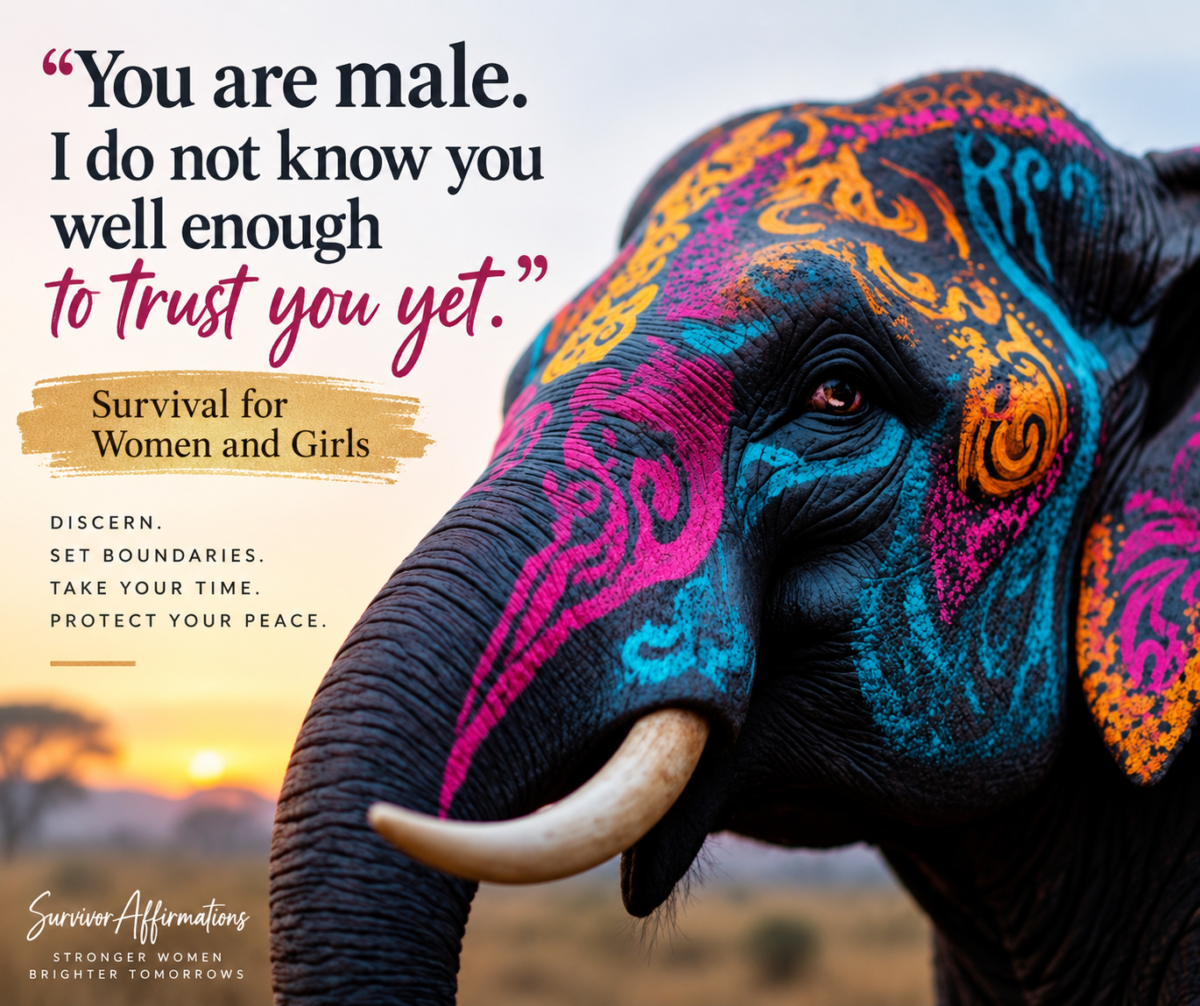
There is a question women are asked to answer that we were never really equipped to answer. How do you know which men are good and which men are da
There is a question women are asked to answer that we were never really equipped to answer.
How do you know which men are good and which men are dangerous?
Women are expected to somehow know. After harm happens, people may search backward through a woman’s choices looking for the moment when she should have known. She should have noticed. She should have seen something. She should have chosen differently.
But dangerous people do not necessarily arrive looking dangerous. Some arrive charming. Some come recommended. Some are respected in their communities. Some know exactly how a trustworthy man is supposed to sound. And some men who eventually cause harm may have behaved beautifully for months or years before a woman saw another side of them.
Perhaps we have been giving women the wrong assignment.
In the wild, African elephants have survived for generations by becoming extraordinarily discerning about danger. Elephant families are organized around females, with experienced matriarchs carrying knowledge that can help the herd navigate a world where survival sometimes depends upon noticing what others miss.
Scientists studying elephants in Kenya discovered something remarkable. When researchers played recordings of human voices, the elephants did not respond to every voice in the same way. They could distinguish between human groups associated with different levels of historical threat. They could also distinguish adult male voices from those of women and boys within the population being studied.
The elephants were listening for information.
They did not need to decide whether the human being speaking was a “good person” or a “bad person.” That question would have been useless to them. What they needed to know was much simpler: What does the information available to me suggest I should do right now?
There is wisdom for women in that. You do not have to determine whether a man is good before deciding how much access he gets to you.
You may not know yet. That is allowed.
A man can tell you he would neverrrrr hurt a woman. His friends may call him a “great guy.” His mother may adore him. His coworkers may respect him. He may be generous, accomplished, religious, politically aware, funny or beloved by children.
Those things tell you something about him. They do not tell you everything.
And his word about his own safety cannot possibly be the only evidence you consider.
We understand this everywhere else. Someone saying, “Trust me, I am honest,” does not replace references, records, safeguards, or time. Yet women are sometimes expected to treat reasonable caution around men as though it were an accusation.
It isn’t.
There is a world of difference between saying “You are a dangerous man” and saying “I do not know you well enough to trust you yet.”
Survivors especially deserve to know that difference.
You are not conducting a criminal trial every time you make a safety decision. You do not need evidence beyond a reasonable doubt to decline a ride, keep your address private, leave a date, refuse a drink, stay out of someone’s house, protect your children or decide that something about an interaction is moving too quickly.
You are deciding how much access another human being gets to your life.
That decision belongs to you.
And this is where the elephant offers another lesson. Discernment is not the same as living frightened of everything. The elephants in the research did not respond identically to every human voice. They made distinctions. They gathered information and adjusted.
Women can do that too.
Watch what happens when a man doesn’t get what he wants. Notice whether kindness survives disappointment. See how he handles the word no. Listen to how he speaks about women who have nothing to offer him. Pay attention when his stories repeatedly require every former partner to be crazy, cruel or dishonest. Notice whether your boundaries make him curious and respectful or offended and punishing.
Then give time permission to do some of the work.
You don’t have to rush to declare him wonderful, and you don’t have to rush to declare him terrible. Sometimes the wisest answer is simply, I don’t know yet.
There is freedom in those four words.
For Survivors, this can be especially important because harm can leave a woman doubting her own judgment. She may become frightened that she will “choose wrong” again. She may swing between trusting too quickly and believing she must become capable of detecting every dangerous person who crosses her path.
Neither burden belongs on her shoulders.
You will never become an instrument capable of perfectly detecting human danger. None of us will.
What you can build is a trustworthy process.
Let trust grow instead of demanding that it appear. Let boundaries gather information. Let consistency speak. Let contradictions speak too. Listen to other women without surrendering your own judgment. Remember what experience has taught you without believing that every new person must repeat the past.
And when you don’t have enough information, you are allowed to move slowly.
The elephant does not survive because she possesses magical knowledge about the heart of every creature approaching her family. She survives because she pays attention, remembers, distinguishes and responds to what she knows without demanding perfect certainty first.
Perhaps women deserve the same freedom.
We do not have to know who all the bad men are.
We do not have to prove who all the good men are.
And we certainly do not have to accept a man’s assessment of himself as the price of being considered kind, fair or open-minded.
A good man’s character will have time to introduce itself.
Until then, let trust walk.
It does not need to run.
You do not owe anyone access while you are still gathering information. Survival has never required perfect knowledge. Sometimes it simply requires enough discernment to protect yourself before certainty arrives.
Why males? Because women are allowed to respond to true patterns that exist in the real world.
Women are not innocent of violence. We do not need to pretend that we are. Women are capable of abuse, exploit, assault and kill, and their victims deserve to be taken seriously.
But acknowledging female violence does not require women to pretend that violence is distributed evenly between the sexes. It isn’t.
Across the world, males commit the overwhelming majority of homicide. Men overwhelmingly perpetrate sexual violence (strangers and people familiar to them). Men are major perpetrators of intimate-partner violence against women, and women and girls remain disproportionately subjected to sexual exploitation and trafficking for sexual exploitation.
Men have also overwhelmingly commanded the armies, governments, and imperial systems through which conquest and colonization were historically carried out.
And male violence does not end with women.
Men and boys live in the world male violence creates too.
The stranger murdered on the street may be male. The teenager shot by another teenager may be male. The man beaten outside a nightclub may be male. The boy recruited into an armed group may be male. The prisoner assaulted by another prisoner may be male. The father killed in a robbery may be male.
Recognizing the sex pattern of violence is therefore not an argument that men do not suffer. Quite the contrary. One of the terrible truths about male violence is how many males it harms.
So when a woman says, “You are male, and I do not know you well enough to trust you yet,” she has not declared every male dangerous. She has acknowledged something much simpler: she cannot tell which unfamiliar male will become dangerous by looking at him.
She is allowed to use the information available to her while she learns more.
That is why “not yet” is such an important phrase.
Trust can grow. A man can demonstrate character. Friendship can deepen. Love can arrive. Wonderful men exist, and women know them, raise them, love them, work beside them and build lives with them.
But goodness does not require women to pretend that risk is unknowable simply because acknowledging what we know makes somebody uncomfortable.
The elephant does not hate the lion because she keeps her calf away from him. She does not owe the wilderness a performance of impartiality. She responds to what generations of survival have taught her.
Women may do the same.
We are not required to accuse every man. We are not required to trust every man either. Between accusation and trust lies a vast, intelligent territory called discernment. Women and girls are allowed to live there.