1. Scapegoating Relieves Pressure on the Group In families that are unstable or abusive, members often project problems onto one person.
1. Scapegoating Relieves Pressure on the Group
-
In families that are unstable or abusive, members often project problems onto one person.
-
The “Black sheep” becomes a lightning rod: blamed for tension, conflict, or failures so others don’t have to face uncomfortable truths.
-
Example: Instead of acknowledging a parent’s drinking problem, the family may focus on the teen who “causes trouble.”
2. Maintaining the Illusion of Normalcy
-
Dysfunctional families often care more about appearances than reality.
-
Labeling one member as the problem allows others to look “healthy” or “blameless.”
-
The Black sheep is sacrificed to preserve the family’s public image.
3. Punishment for Non-Conformity
-
Black sheep are often the ones who see, speak, or resist what others want hidden.
-
They might question harmful traditions, point out abuse, or simply have different values.
-
In unhealthy families, independence = threat. The punishment is isolation and labeling.
4. Projection of Shame & Fear
-
Parents who cannot face their own wounds often project them onto one child.
-
Example: A mother who was silenced as a child may call her outspoken daughter “difficult” or “angry.”
-
The family’s denied pain gets deposited into the Black sheep.
5. Power and Control Dynamics
-
Dysfunctional families often operate like small power systems.
-
Creating a “Black sheep” keeps the others aligned with authority — if you step out of line, you could be next.
-
This teaches compliance and silence, especially around abuse.
6. Survival Strategy for Other Members
-
Siblings or other relatives may unconsciously accept the scapegoat role for one person because it protects them from being targeted.
-
“Better them than me” becomes the silent agreement.
7. Cycle of Silence & Denial
-
Over time, the Black sheep may internalize the role, feeling like they truly are the problem.
-
This is tragic because in many cases, the Black sheep is the most truth-telling, sensitive, or justice-seeking person in the family.
✨ Big Picture
The Black sheep role exists because dysfunctional families need a release valve for their dysfunction. But that “release” doesn’t heal anything — it simply isolates one member to carry the burden for everyone else.
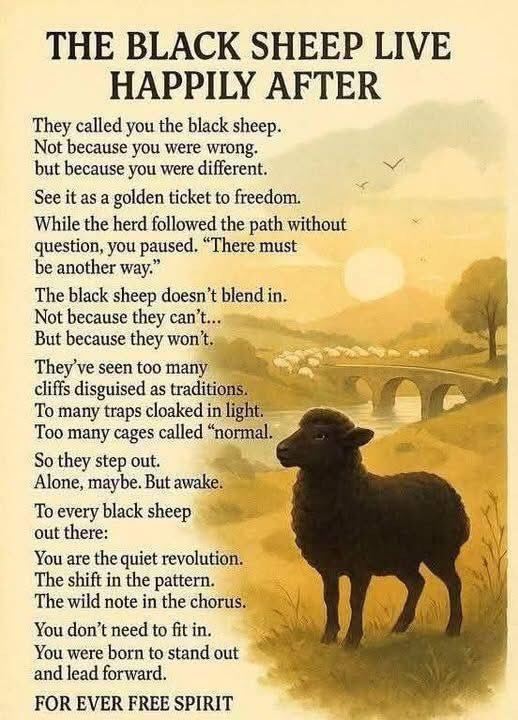
In reality, the Black sheep is often:
-
the truth-teller,
-
the pattern-breaker,
-
and the one most capable of healing outside the family system.