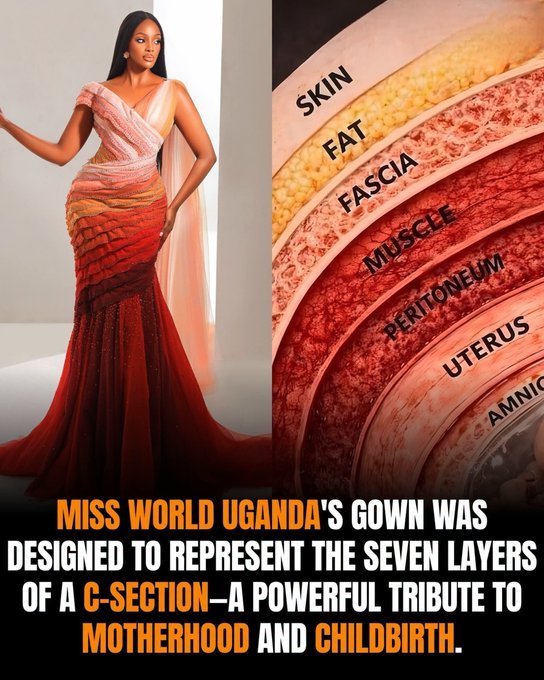
There are dresses designed to make us look. Then there are dresses designed to make us understand. When Miss World Uganda Muhoza Trivia Elle appeare
There are dresses designed to make us look.
Then there are dresses designed to make us understand.
When Miss World Uganda Muhoza Trivia Elle appeared in a remarkable gown called Layers of Life, she was certainly beautiful. The silhouette was dramatic, sculpted and elegant, moving through shades of cream, rose and deep red. Yet Ugandan designer Keesha Abdallah had placed another story inside all that beauty.
The gown was inspired by Caesarean birth.
Abdallah, herself a new mother, designed the dress to represent the layers of a woman’s body involved in a C-section. The concept transformed anatomy usually seen in medical illustrations into couture. On an international stage where women’s bodies are so often admired from the outside, these two Ugandan women invited us to look deeper.
And once you do, it becomes difficult to look at a scar quite the same way again.
We See the Scar. We Don’t See the Layers.
A C-section scar can eventually become a thin line across a woman’s abdomen.
That little line can fool the eye.
We see healed skin and think we are seeing the whole event. We are not seeing the surgical journey underneath it, the tissues that had to heal, the uterus that carried a child, the medical care, the pain, the exhaustion or the woman learning how to move through ordinary life while recovering from major surgery.
We certainly cannot see what the experience meant to her.
Perhaps she was frightened. Perhaps everything went beautifully. Perhaps it saved her life or her baby’s life. Perhaps the birth was not what she had hoped for. Perhaps she felt tremendous relief. Perhaps there were complications. Perhaps she remembers extraordinary kindness from the medical team. Perhaps parts of that day remain difficult to think about.
The scar cannot tell us.
It is only what reached the surface.
And aren’t we forever making that mistake with one another?
We look at what remains visible and decide we know how deep something went.
Sometimes We Even Do It to Ourselves
Women can be terribly unforgiving when looking backward.
We remember the decision we wish we had made differently. The relationship we stayed in longer than we now think we should have. The years when we were drinking too much. The time we returned after promising ourselves we wouldn’t. The money we lost. The person we trusted. The warning we missed. The thing we said when we were hurting. The body that changed. The weight that came. The scar that stayed.
We look at the visible result and put ourselves on trial.
What we don’t always remember are the layers.
What did you know then?
What were you afraid of?
What resources did you have?
Who was helping you?
Who wasn’t?
What had you been told repeatedly about yourself?
Were you grieving? Exhausted? Being bullied? Trying to keep children safe? Caring for an aging parent? Recovering from violence? Living with somebody who kept moving the ground beneath your feet?
Were you trying to survive Tuesday while your future self now sits comfortably in Friday’s knowledge judging what you should have done?
Context does not make every choice a good choice. It does something more useful.
It helps us understand the human being who made it.
Understanding ourselves clearly gives us somewhere to begin.
Keesha Abdallah Did Something Beautiful With Knowledge
There is something particularly moving about the designer being a new mother herself.
Keesha Abdallah took something clinical and made it visible without making it ugly. She took something women may carry quietly beneath their clothes and gave it ceremony. Anatomy became fabric. Surgery became design. A part of women’s experience that can disappear behind the cheerful announcement that “mother and baby are doing well” received its own moment in the light.
Then Muhoza Trivia Elle carried that vision onto an international stage.
That deserves its own recognition.
A designer can create a message, but somebody still has to agree to wear it.
Elle could have worn a gown whose only assignment was to make her look beautiful. Instead, her beauty carried an idea about other women’s bodies. Together, designer and wearer turned fashion into a conversation about childbirth, recovery and what exists beneath what we can see.
Neither woman had to deliver a lecture.
The dress did the talking.
Your Body Is Not an Apology
Some women love their C-section scars. Some barely think about them. Others struggle with them.
There is room for all of that.
A woman does not owe anybody a triumphant relationship with every mark on her body. She doesn’t have to call every scar beautiful before she is permitted to make peace with herself.
But she deserves accurate information about what her body has been through.
Sometimes that information changes the conversation.
Instead of looking at a C-section scar and thinking, Why doesn’t my stomach look the way it used to?, she may begin to understand the extraordinary physical event from which her body recovered.
Instead of What’s wrong with me?, a better question may become, What happened to me?
And sometimes, after learning more, another question becomes possible:
What do I need now?
There is no shame in needing a physician to help answer that question. Or a therapist. Or a physical therapist. Or somebody knowledgeable about pelvic health. Or a trusted friend who will sit beside you at an appointment and help you remember what you wanted to ask.
Knowing when another person’s expertise could help you is not evidence that you are incapable.
Quite the opposite.
There Are Scars Nobody Can Photograph
Perhaps that is why Layers of Life reaches beyond childbirth.
Most of us have something people cannot see.
A woman who survived years of bullying may still hear an old insult when she enters a room full of strangers.
Someone recovering from addiction may carry memories she wishes she could erase alongside enormous pride in the life she is building now.
A Survivor of violence may have no visible injury at all.
A woman who was humiliated about her body at sixteen may still hear that voice at fifty-six.
Someone may be carrying the aftermath of something she has never told another living soul.
And sometimes the scar isn’t an injury at all. It is the memory of our own mistake.
We can become so ashamed of one chapter that we let it narrate the entire book.
But a human life has layers too.
There was a before. There was what happened. There was what you understood at the time. There were circumstances nobody else knew about. There were people who helped and people who failed to help. There were things you did beautifully and things you would do differently now.
Then there was everything you learned afterward.
A scar cannot hold all of that information.
Neither can a photograph, a rumor, a medical chart, an old arrest, a relapse, a divorce, a bad relationship, somebody else’s opinion of you, or the worst decision you ever made.
None of them is large enough to contain a whole human being.
Look Again
That may be the quiet genius of Layers of Life.
At first, we see a beautiful woman in a beautiful dress.
Then Keesha Abdallah tells us what the dress represents, and suddenly our eyes know more.
We look again.
That second look is a kindness we could offer ourselves more often.
Look again at the body you criticize. It has a history.
Look again at the scar you hide. There are layers beneath it.
Look again at the woman you used to be. She knew less than you know now.
Look again at the years you are embarrassed about. Something may have been happening there that deserves understanding alongside accountability.
Look again at what somebody convinced you was evidence that you were stupid, weak, ugly, impossible, damaged or beyond help.
You have more information now.
You are allowed to reconsider the verdict.
There are physicians who can explain bodies. Therapists who understand recovery. Attorneys who understand rights. Social workers who know systems. Advocates who know resources. People who understand addiction, grief, trauma, disability, money, housing, parenting, aging, employment and the thousand practical problems that can make a difficult season feel impossible.
Sometimes the next chapter begins simply by discovering that somebody knows something you didn’t know.
There is a much larger world outside shame.
Muhoza Trivia Elle and Keesha Abdallah gave us a gorgeous way to remember that. A scar may be the first thing the eye notices, but it is never the whole story.
There are always layers.
And before you decide what a scar says about a woman, especially when that woman is you, it might be worth learning what happened underneath.