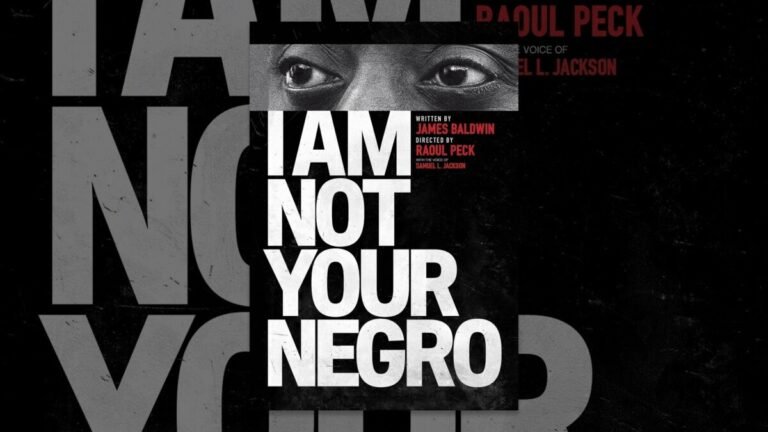
2016 documentary | Directed by Raoul Peck | Based on the writings of James Baldwin
What happens when society spends more time examining the reactions of people being mistreated than examining the conduct of those mistreating them?
I Am Not Your Negro is one of those documentaries that asks you to reconsider what America has taught itself about racism, innocence, history, and progress.
The film draws on James Baldwin‘s unfinished manuscript, Remember This House, about three murdered civil rights leaders he knew: Medgar Evers, Malcolm X, and Martin Luther King Jr.
What makes the documentary so fascinating is that Baldwin is not simply examining how Black Americans were treated. He is examining what white Americans had to believe, deny, and normalize to permit that treatment.
Here are seven especially revealing ideas.
1. Racism is not only about hatred. It is also about the stories people need to believe.
Baldwin understood that racism survives through more than openly hateful people. It also survives through ordinary citizens who accept comforting explanations for injustice.
If a society insists that it is fair, civilized, and generous, what happens when the evidence says otherwise?
Baldwin pushes us toward an uncomfortable possibility: people may defend a false picture of their country because admitting the truth would require them to reconsider their own participation.
The fascinating question: How much injustice can survive simply because people would rather preserve their innocence than examine their behavior?
2. America taught itself to see Black people through fictional characters.
Baldwin’s analysis of Hollywood is among the documentary’s most revealing features.
He examines the racial messages embedded in American entertainment, including the Westerns and heroic figures that generations of children grew up admiring.
Consider the familiar scene of cowboys fighting Native Americans. Children were encouraged to identify with the cowboy, the supposed hero, without necessarily understanding whose land was being taken or whose humanity was being erased.
Baldwin recognized that entertainment was doing something powerful. It was teaching audiences whom to admire, whom to fear, and whose suffering barely deserved consideration.
This raises a question that remains relevant to modern media: When an audience has been trained to see one group as dangerous, how much evidence does it take to change that perception?
3. Medgar Evers, Malcolm X, and Martin Luther King Jr. were different men, but all three were murdered.
Baldwin knew these men personally. Their political philosophies, methods, and public reputations were not identical.
Medgar Evers worked through civil rights organizing and legal challenges. Malcolm X offered a forceful critique of white supremacy and emphasized Black self-determination. Martin Luther King Jr. championed nonviolent resistance.
Yet none of their different approaches protected them from assassination.
There is something sobering about that comparison. It challenges the comforting idea that oppressed people can always secure their safety by choosing the correct tone, strategy, or manner of protest.
The question: If people pursuing different approaches to Black freedom all faced deadly violence, was the central objection really to their methods, or to the changes they demanded?
4. The idea of progress can become a way to avoid responsibility.
Baldwin was not denying that civil rights victories mattered. He was questioning the temptation to treat those victories as proof that the deeper problem had been solved.
A country can remove discriminatory laws while retaining attitudes, institutions, and economic arrangements shaped by generations of discrimination.
The documentary’s movement between historical footage and more contemporary images makes that argument visually.
Progress is real, but it is not automatically permanent or complete.
The lesson: Celebrating how far a country has come should never become an excuse for refusing to examine where it still fails.
5. Baldwin believed America’s racial problem revealed something about white America, not Black inferiority.
This may be the documentary’s most important reversal.
For generations, public debates treated Black Americans as the problem to be studied, explained, educated, corrected, or integrated.
Baldwin challenged the premise.
Why should Black Americans have to explain their humanity? Why weren’t Americans examining the people who needed segregation, racial hierarchy, and myths of Black inferiority?
He was asking what racism revealed about the people practicing it.
The lesson: Sometimes the people being endlessly examined are not the people whose behavior most urgently needs examination.
6. A Black child trying to attend school exposed the moral failure of grown adults.
One of the documentary’s memorable historical images is 15-year-old Dorothy Counts, who faced a hostile white crowd while integrating Harding High School in Charlotte, North Carolina, in 1957.

A teenage girl wanted an education. Adults treated her presence as a threat to their social order.
Baldwin understood that children often reveal the contradictions adults have learned to rationalize. Dorothy was not creating the crisis. The adults surrounding her were exposing one.
The question: What kind of social arrangement requires grown people to humiliate a child in order to preserve it?
7. Baldwin refused to accept that Black Americans should be grateful for being included in their own country.
In a famous 1968 television exchange with Dick Cavett, featured at the beginning of the documentary, Cavett points to signs of racial progress, including Black political representation and appearances in television commercials.
Baldwin refuses to treat those developments as the final measure of justice.
His concern reaches beyond whether Black Americans will eventually be accepted. He questions what will become of a country that has built so much of its identity around denying the humanity of part of its own population.
There is a difference between being permitted to participate and being recognized as someone who belonged all along.
The lesson: Equal citizenship is not a favor bestowed by the powerful. It is a standard against which their conduct must be judged.