The extraordinary story behind Norman Rockwell’s painting of Ruby Bridges, and what it teaches us about courage, art, dignity, and the power of telling the truth.
There are paintings we admire because they are beautiful. Others stay with us because they tell us something about the world. And then there are those rare works of art that seem to grow more powerful the longer we look at them.
Norman Rockwell’s The Problem We All Live With is one of those paintings.
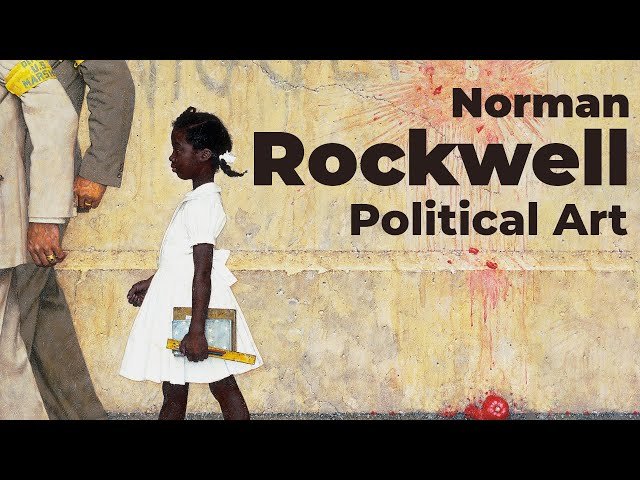
It depicts six-year-old Ruby Bridges walking to school in New Orleans in 1960, escorted by four federal marshals. She was one of the first Black children to desegregate the city’s previously all-white elementary schools.
She was a little girl going to school.
That should have been the whole story.
Instead, angry white segregationists gathered to protest her presence. Federal marshals had to protect her as she walked into William Frantz Elementary School.
And years later, an artist famous for painting America’s everyday life would make that little girl’s walk impossible to forget.
The Artist Who Was Told What He Could Not Paint
For decades, Norman Rockwell created illustrations for The Saturday Evening Post. His paintings became part of America’s cultural memory.
He painted families, children, neighbors, celebrations, and the small moments of ordinary life.
But there was something missing from much of that America.
Black people.
Rockwell worked under editorial restrictions that limited how Black Americans could be portrayed. He later recalled being required to remove a Black person from an illustration because the magazine permitted Black figures primarily in subordinate service roles.
Think about that.
An artist celebrated for showing America as it lived was working within rules that restricted whose lives could be shown.
In 1963, Rockwell ended his long association with The Saturday Evening Post. At Look magazine, he found greater freedom to address racial injustice and other difficult subjects.
And in 1964, Americans opened Look to find something extraordinary.
A Black child walking to school.
He Didn’t Paint the Angry Crowd. He Painted Ruby.
This is where Rockwell’s artistic choices become especially powerful.
He could have filled the painting with the faces of angry segregationists. He could have shown people screaming, threatening, and protesting.
He could have made the four federal marshals the central heroes of the scene.
But he didn’t.
Instead, he painted Ruby Bridges.
She wears a white dress. Her shoes and socks are neat. She carries her school supplies. Her small figure walks between four enormous men whose heads are cropped out of the painting.
There is racist graffiti on the wall behind her. A smashed tomato stains the scene.
We know there is hatred surrounding this child.
But Rockwell refuses to give that hatred the center of his painting.
He gives that space to Ruby.
And once you notice this, it is difficult to look at the painting the same way again.
She Is Not Asking Us to Feel Sorry for Her
One of the most remarkable things about Rockwell’s portrayal is Ruby’s posture.
She is walking forward.
She isn’t looking toward the viewer. She isn’t pleading for sympathy. She isn’t performing sadness or fear for an audience.
She is simply going where she has every right to go.
We cannot know everything Ruby was feeling from the painting. The real child endured an experience no six-year-old should have faced.
But Rockwell made an extraordinary artistic decision.
He showed the injustice without making the child’s suffering her entire identity.
Ruby is not presented as a helpless figure waiting to be rescued.
She is a little girl with somewhere to be.
And the adults surrounding her, along with the nation watching, are forced to confront why something so ordinary required such extraordinary protection.
Ruby Lived the History. Rockwell Helped America See It.
There are two different kinds of courage in this story, and they deserve to be understood separately.
Ruby Bridges was a child. She did not create the circumstances she faced, and she should never have been required to carry such a burden.
Her courage belonged to her, but the responsibility for protecting her belonged to the adults and institutions around her.
Norman Rockwell was a grown man with an established reputation and an extraordinary artistic gift.
He had choices about what he would paint and whose stories he would help tell.
And after years of working within restrictive editorial rules, he created a painting that confronted American racism directly.
He did not make himself the hero of Ruby’s story.
He used his art to make her visible.
That distinction is beautiful.
Because we do not have to place ourselves at the center of someone else’s struggle to make a meaningful contribution.
Sometimes our responsibility is to witness, document, preserve, and tell the truth.
This Is What Art Can Do
Art can teach history without delivering a lecture.
It can challenge an institution without naming every person responsible.
It can preserve a moment that powerful people might prefer future generations to forget.
And it can help people recognize the humanity of someone whose experiences they have never shared.
Rockwell’s painting did not end segregation or accomplish the work of the Civil Rights Movement. That struggle belonged to generations of Black Americans, families, organizers, lawyers, and children who endured tremendous injustice.
But his painting became one way their history could reach people across generations.
More than sixty years after its publication, we are still looking at Ruby Bridges.
Still asking questions.
Still learning.
That is an extraordinary legacy for a work of art.
The Stories Behind the Art Deserve to Be Told, Too
There is something wonderful about discovering the history behind a familiar painting.
We learn about a little girl whose family insisted that she receive the education she deserved.
We learn about the restrictions that once shaped what a celebrated American illustrator could show.
And we learn what became possible when that artist had greater freedom to tell a different kind of American story.
The painting becomes more than an image.
It becomes a lesson about courage, artistic responsibility, historical memory, and the importance of deciding whose humanity deserves our attention.
And perhaps most importantly, it reminds us that people experiencing injustice do not exist merely to illustrate suffering.
They have names. Families. Childhoods. Dreams. Futures.
Ruby Bridges went on to live a life far beyond that famous walk. She became an author and civil rights advocate, continuing to teach new generations about equality and education.
Her life did not end at the schoolhouse door.
And that deserves our attention, too.
A Beautiful Lesson to Carry Forward
There are many ways to contribute to a better world.
Some people organize. Some teach. Some document. Some protect. Some write. Some paint.
And sometimes one person’s gift helps preserve another person’s courage for generations.
Norman Rockwell gave America an image it could not easily look away from.
Ruby Bridges gave that image its extraordinary human story.
Ruby lived the history. Rockwell helped America see it.
And perhaps that is one of the greatest possibilities of art: not merely to show us what happened, but to help us understand whose lives, dignity, and courage must never be forgotten.
A reflection to carry with you:
When we tell stories about people who have experienced injustice, are we giving their suffering all the attention, or are we making room for their humanity, courage, and the fullness of their lives?
Sometimes the most powerful thing we can do is make sure the person remains larger than what happened to them.