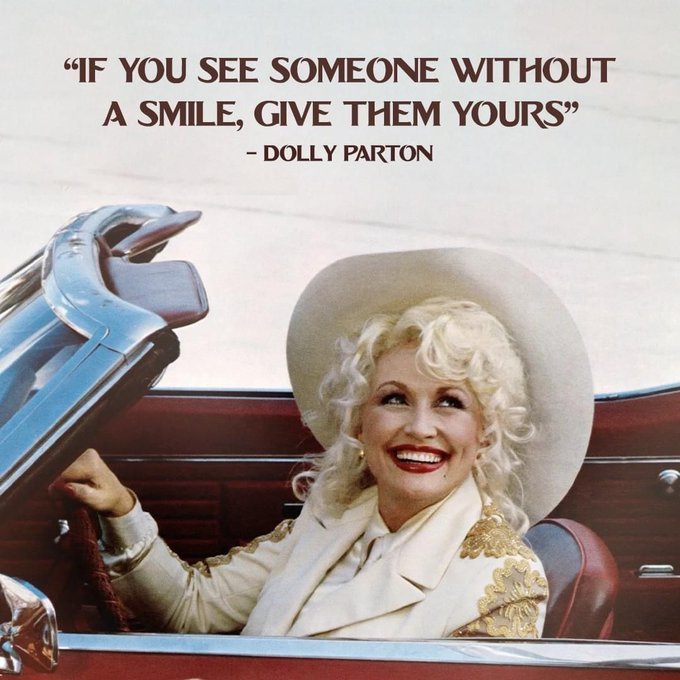
I think some artists enter your life so early that you cannot remember becoming a person without them. Their voices get mixed up with childhood itself
I think some artists enter your life so early that you cannot remember becoming a person without them. Their voices get mixed up with childhood itself: the rooms you lived in, the things you loved, the first private discoveries that belonged entirely to you. Dolly Parton was that kind of artist for me.
When I was a child, I wasn’t much for requesting toys. I wanted books. I wanted art sets and an Etch A Sketch. And I desperately wanted a record player. So at the age of five, I got a record player of my own.
When I finally got my record player, relatives and my mother’s friends began giving me albums and 45s. For the younger folks, a “45” was the smaller record, usually with one song on each side. And somewhere in that childhood world, I found Dolly.
One of the first songs of hers that captured me was “Me and Little Andy.” To my young ears, it sounded almost like a song made for children, a little story carried by this extraordinarily sweet voice. I didn’t yet have language for what Dolly could do as a songwriter and storyteller. I only knew I wanted to listen.
Then there was “Here You Come Again” on the radio. That voice.
Dolly Parton sounded like an angel to me when I was a child, and somehow she never stopped sounding like one.
Today, Dolly Parton died at 80, after a life so astonishingly creative that simply listing her accomplishments feels inadequate. I don’t think I can write about her only as a famous person who has died. Her music has been a guiding light for me for practically my entire life. She belongs to my earliest memories of understanding that music could tell stories, that a woman’s voice could contain sweetness and sorrow and humor and intelligence all at once.
And Lord, that woman was talented.
She could write. She could sing. She could harmonize. She could act. She understood comedy. She understood audiences. She understood spectacle. She understood exactly what that enormous blond hair, those rhinestones, those heels and that tiny waist were doing, and she was usually several steps ahead of anybody who thought the joke was on her.
I loved her in the movies, but especially in 9 to 5. She was beautiful, of course, but what I remember most is how much fun she was to watch. There was joy in her. Mischief. Timing. She could be glamorous without becoming remote. You never got the feeling beauty had imprisoned her inside some requirement to be solemn about herself.
That may be one of the things I loved most about Dolly: she seemed to enjoy being Dolly Parton.
For a woman who became one of the most recognizable people on Earth, she also understood something many famous people never learn: the public does not have to own everything.
She protected her marriage to Carl Dean with remarkable consistency. They were married for nearly sixty years before his death in 2025, and despite decades of fascination with him, she allowed their life together to remain largely theirs. There was something quietly instructive in that. Dolly could give the world an enormous amount of herself without confusing generosity with total access. Her family, her husband, her friendships, the people she loved privately could remain human beings rather than extensions of the Dolly Parton story.
But when it came to creativity, she often did the opposite. She opened the door.
I loved hearing her talk about songs: where they came from, how they changed, who sang them, what another artist brought to them. She understood collaboration without behaving as though another person’s brilliance diminished her own.
And there may be no lovelier example than “I Will Always Love You.”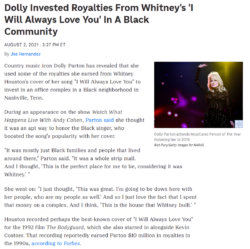
Dolly wrote it. Whitney Houston took that already extraordinary song and made a recording so monumental that generations of people came to know it through her voice. Dolly never seemed threatened by that. She spoke proudly about what Whitney had done with her song. There was room in her understanding of art for both women to be magnificent.
I have always loved that.
Because “I Will Always Love You” belongs to one of the most beautiful traditions in art: somebody makes something, somebody else encounters it, and through another imagination it becomes something neither artist could have created alone. Dolly let us see a little of that process throughout her career. She wasn’t precious about pretending creativity happened by magic. She talked about writing. She talked about musicians. She collaborated across genres and generations. She let us peek behind the curtain and see that making beautiful things is work, play, instinct, craft, trust and sometimes the miraculous meeting of people who know how to recognize one another’s gifts.
She recognized gifts. She shared hers.
And then there were the books.
Dolly came from extraordinary poverty in the mountains of East Tennessee, one of twelve children, and grew into a woman who could have spent the rest of her life simply enjoying what she had earned. Instead, she built the Imagination Library, sending books to children free of charge. By the end of 2025, the program had distributed more than 300 million books.
I keep thinking about that today because I was the little girl who wanted books and a record player.
Dolly understood that giving a child a book is not a small gesture. You don’t know where that book is going. You don’t know what room that child is sitting in. You don’t know whether there are many books in that house or none. You don’t know which sentence will lodge itself inside that child’s imagination and stay there for fifty years.
You send the book anyway.
That was Dolly’s particular kind of generosity. It wasn’t only charity. There was imagination inside it.
She remembered being a child.
She remembered where she came from without making poverty picturesque. She grew up in a family with very little money in rural Tennessee and somehow carried those beginnings into an enormous life without treating the people she came from as embarrassing evidence of a self she had escaped. She could become fantastically successful and still sound like home.
And her heart seemed capable of traveling farther than the boundaries people wanted to draw around her.
Dolly loved people. Not just people who looked like her. Not just people who lived like her.
There was something deeply Dolly about refusing to make human affection that small.
She was a woman of faith who seemed far more interested in loving people than policing them. She moved through country music, Hollywood, business, philanthropy and American public life while retaining something increasingly rare: the ability to belong to people who did not necessarily belong to one another.
Maybe that is part of why this loss feels so enormous.
There was the young woman from the Tennessee mountains with an enormous voice and enormous ambition. There was the country star. The songwriter. The crossover pop star. The movie star making us laugh in 9 to 5. The businesswoman. The philanthropist putting books into children’s hands. The elder artist still curious about what she might make next.
And through every version, unmistakably, there was Dolly. The hair got higher. The rhinestones multiplied. The world changed around her. That voice remained.
Today I find myself back with that little record player.
Back when music came inside a cardboard sleeve and a child could sit on the floor holding a 45 by its edges, trying not to put fingerprints on the grooves. Back when I didn’t know anything about music publishing or songwriting credits or crossover records or cultural legacies. I didn’t know that I was listening to one of the great American songwriters.
I just knew the lady singing “Me and Little Andy” sounded beautiful.
I knew “Here You Come Again” made me want to hear it again.
Sometimes a child’s ear knows before the rest of us catches up.
Dolly Parton was our living angel for a very long time. Not because she was perfect, and not because we needed to turn a complicated human life into sainthood after death. She was something much more interesting than that. She was tremendously, almost outrageously alive. Funny and ambitious. Private and generous. Shrewd and tender. A woman who understood the machinery of show business and still believed a song could reach one lonely person somewhere and mean something.
She made beautiful things for more than seven decades.
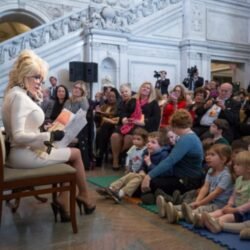
The Library is devastated to learn of the passing of DollyParton, a music legend and titan of children’s literacy. Her Imagination Library program has earned multiple Library Literacy Awards and, in 2018, she visited us to donate its 100 millionth book to our collection and host a story time. 🦋❤️
She made people laugh.
She put books in children’s hands.
She gave other artists room to shine.
She showed us some of the work behind the wonder.
And for some of us, she sang so early in our lives that her voice became part of the architecture.
I don’t remember a world before Dolly Parton.
Tonight, I suppose, is the first night we have to learn what a world after her feels like.
But somewhere there is still a record turning.
And that voice is still coming through.
