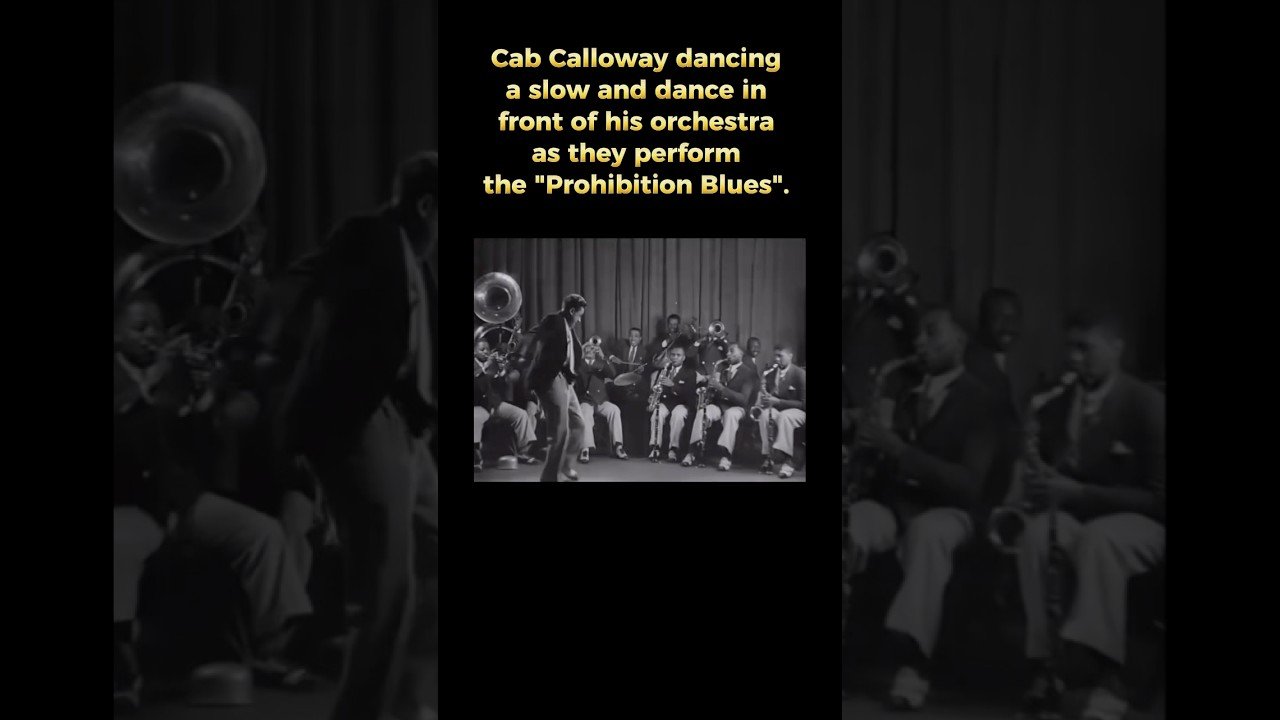
I like Bob Fosse too. He was a brilliant dancer and choreographer. But his style is heavily influenced by Black dancers. You can't even put too mu

I like Bob Fosse too. He was a brilliant dancer and choreographer. But his style is heavily influenced by Black dancers. You can’t even put too much “heavy” on the “heavily influenced.”
American stage entertainment keeps putting white names on Black-rooted brilliance. Fosse is one later example of that pattern, not the beginning of it.
Before Broadway called it style, Cab Calloway had already made the body wink, glide, snap, testify, flirt, command, and swing.
I remember watching old black-and-white movies of Cab Calloway, and it always appeared that he was being mischievous. As a kid who was concentrating hard on “being good,” I loved it. Naughtiness in art. So tasteful though.
He appeared in Janet Jackson’s “Alright” video, and it was so amazing. Cab Calloway, Cyd Charisse, the Nicholas Brothers, and Heavy D. All-star talent lineup. That video was culture-packed and stacked. Textured.
Here are 10 surprising facts about Cab Calloway’s dance style and why he matters when we talk about what later became “iconic” American jazz performance.
-
He was not “just” a singer. His whole body was part of the music.
Cab Calloway performed as a singer, bandleader, dancer, actor, and master of ceremonies. His genius was not only vocal. He moved like the rhythm had entered his bones and come back out through his shoulders, knees, hands, face, and feet. The Library of Congress described him as one of the most magnetic and energetic entertainers in American culture. -
His movement style helped animate cartoons. Literally.
In the 1930s, Calloway appeared through rotoscoping in Fleischer Studios’ Betty Boop cartoons. That means animators traced or modeled animated character movement from filmed footage of him dancing and performing. So when people watched those surreal cartoon figures move, they were seeing Cab’s Black performance style translated into animation. PBS notes his role in those Betty Boop cartoons as singer, dancer, and bandleader. -
He had a glide that some later observers connect to the moonwalk lineage.
In his early films, Calloway can be seen doing a smooth backward-gliding step. Some writers have described it as a precursor to Michael Jackson’s moonwalk. Calloway himself reportedly said it was called “The Buzz” back then. That matters because it shows that “new” pop dance moves often have older Black stage roots. -
His dance was full of controlled eccentricity.
Cab could look wild without being sloppy. That is a rare gift. The flailing arms, bent knees, loose shoulders, big facial expressions, sudden freezes, and sharp turns were not random. They were stage intelligence. Britannica describes his performance of “Minnie the Moocher” as energetic and eccentric, which is exactly the point: eccentricity was part of his mastery, not a lack of refinement. -
He danced like a bandleader, not a backup dancer.
His body often worked like a conductor’s baton. He used gestures to command the band, tease the audience, cue call-and-response, and ride the rhythm. That is different from choreography that only decorates the music. Cab’s movement helped govern the room. -
His style carried vaudeville, jazz, and Black social dance all at once.
Calloway’s performance vocabulary sat at the meeting place of Black vaudeville, swing, scat, tap-adjacent footwork, jive talk, nightclub performance, and theatrical comedy. That is why he matters to the Fosse conversation. Fosse later became famous for stylized jazz theatricality, but Cab had already been turning rhythm, comedy, sexuality, precision, and spectacle into full-body performance decades earlier. -
His face was part of the choreography.
Cab’s eyebrows, eyes, mouth, grin, and stare all “danced.” That may sound small, but it is not. Later Broadway jazz uses facial expression as part of the line. Cab’s performance reminds us that Black entertainers had already mastered the full body as instrument: feet, hips, shoulders, face, voice, timing, and audience control. -
He made call-and-response physical.
“Minnie the Moocher” is famous for its “hi-de-hi-de-hi-de-ho” call-and-response pattern. But Calloway did not only sing call-and-response. He moved it. He would lean in, pull back, gesture, challenge, invite, and dare the audience to keep up. The song became famous partly because the audience repeated his scat phrases until they became too complex to follow. -
He brought elegance and danger together.
Cab could wear a white tuxedo and still feel like lightning had entered the room. That combination matters. He was not performing respectability in a stiff way. He was stylish, sensual, mischievous, precise, and unpredictable. That is a Black performance tradition: dignity without dullness, polish without surrendering heat. -
His style helps prove the larger point: Fosse did not invent the language. He inherited a world already moving.
When people see hunched shoulders, turned-in knees, tilted hats, isolations, finger work, sly sensuality, and theatrical cool in later Broadway jazz, they should remember artists like Cab Calloway, the Nicholas Brothers, Bill Robinson, Josephine Baker, the Whitman Sisters, and so many Black vaudeville and nightclub performers. Cab’s body was already making rhythm visible.
If you ever get the opportunity to see HBCU drum majors p-e-r-f-o-r-m, you see elements of this style there too. Playful and exaggerated movements. Commanding an entire football field.
Vaudeville was officially white-controlled, but it was culturally indebted to Black performance.
Black performers and African American vernacular dance were doing much of this long before Bob Fosse became “Bob Fosse.” Fosse did not invent jazz dance from nowhere. He stylized, theatricalized, packaged, sharpened, and commercialized movement vocabularies that had deep Black roots, then blended them with burlesque, vaudeville, Broadway staging, and his own physical quirks.
Vaudeville was not predominantly Black Southern in ownership or official structure, but Black Southern performance traditions deeply fed American vaudeville. Black artists carried spirituals, blues, ragtime, tap, buck-and-wing, cakewalk, comic timing, call-and-response, vernacular dance, and embodied rhythm into the national stage. The industry often exploited, segregated, and underpaid them, but it also borrowed heavily from their genius.
Black performers had their own segregated vaudeville circuits because racism kept many out of white-controlled circuits. The Theater Owners Booking Association, known as T.O.B.A., became a major circuit for Black performers in the 1920s and trained or supported artists such as Bessie Smith, Ethel Waters, Cab Calloway, Count Basie, the Nicholas Brothers, and others. Performers famously joked that T.O.B.A. meant “Tough on Black Artists,” which tells you plenty.
The Southern connection is real too. Black vaudeville circuits and touring shows had strong Southern roots, including Black-owned or Black-led venues and touring operations in places like Florida, Georgia, Alabama, Mississippi, Texas, and Louisiana. Those circuits helped create pathways for Black musicians, dancers, comedians, and theatrical performers when mainstream vaudeville shut doors or demanded humiliating conditions.
Before Fosse made it Broadway language, Black performers had already made rhythm theatrical, hips articulate, shoulders expressive, feet percussive, comedy musical, and sensuality precise. Vaudeville did not give Black people rhythm. Black people gave American vaudeville much of its rhythm.
It is disheartening.
Because it is not just about dance. It is about a pattern: people take the fire, rename it, sell it, archive it, teach it, and sometimes leave the original flame-bearers out of the room.
But there is still power here. Because once you see it, you can name it. Once you name it, you can teach it. Once you teach it, you help restore the line.
Here are affirmations that can come from Cab Calloway’s story:
1. I honor the source, even when the spotlight forgot.
What was hidden is not lost when somebody remembers with care.
2. My brilliance does not become smaller because someone else renamed it.
Credit may be delayed, but truth keeps its own records.
3. I come from people who made rhythm out of restriction.
They were denied rooms and still changed the room.
4. I do not need permission to restore the names of my people.
Remembrance is holy work.
5. I can study what was stolen without letting grief steal my breath.
I can grieve, learn, create, and keep moving.
6. My culture is not a footnote.
It is foundation, architecture, pulse, and proof.
7. I carry a lineage of movement, wit, style, timing, and survival.
What they called “influence” was often inheritance taken without thanks.
8. I will not confuse fame with origin.
The famous name is not always the first name.
9. I am allowed to correct the record with beauty.
Truth does not always have to arrive as argument. Sometimes it arrives as art.
10. I can turn disappointment into devotion.
Every forgotten name I speak becomes part of the altar.
11. The archive is not closed.
We can still add the names they left out.
12. My people’s genius did not begin when institutions recognized it.
It was alive in porches, clubs, church basements, back rooms, stages, and streets.
13. I can be tender with the ache and fierce with the truth.
Both belong.
14. I do not inherit erasure. I interrupt it.
I do not have to pass silence down.
15. The rhythm remembers.
Even when the textbook forgets, the body knows.
I remember the source.
I speak the name.
I honor the body that moved first.
I do not mistake applause for origin.
I do not mistake branding for birth.
The rhythm remembers.
And so do I.
